
Parts of Stairs: Names and Functions of Every Staircase Component
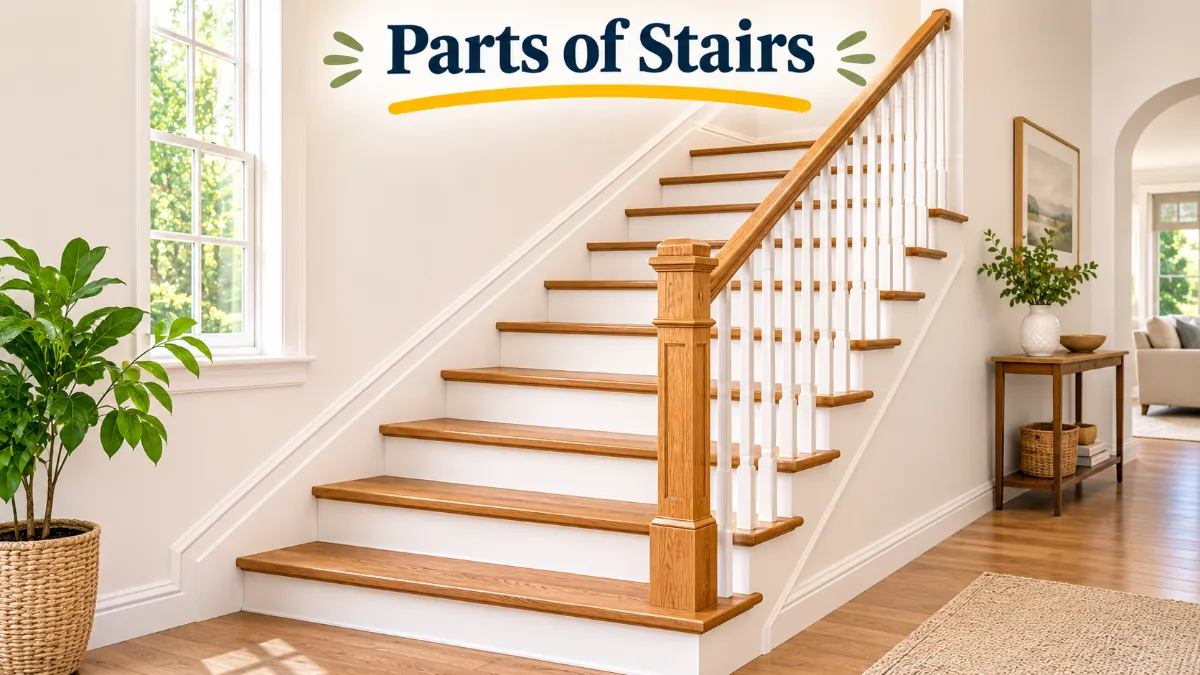
The main parts of stairs are the tread (the flat part you step on), the riser (the vertical face between treads), the nosing (the tread edge that overhangs), the stringer (the side support), the handrail, the balusters and the newel posts. Landings and winders handle turns, and the balustrade is the whole railing system. Below, each stair part name is defined in plain language, with notes where stair companies disagree.
Parts of Stairs at a Glance
Wood Stair Co groups them into step parts, support parts and safety parts, which is a handy way to remember them.
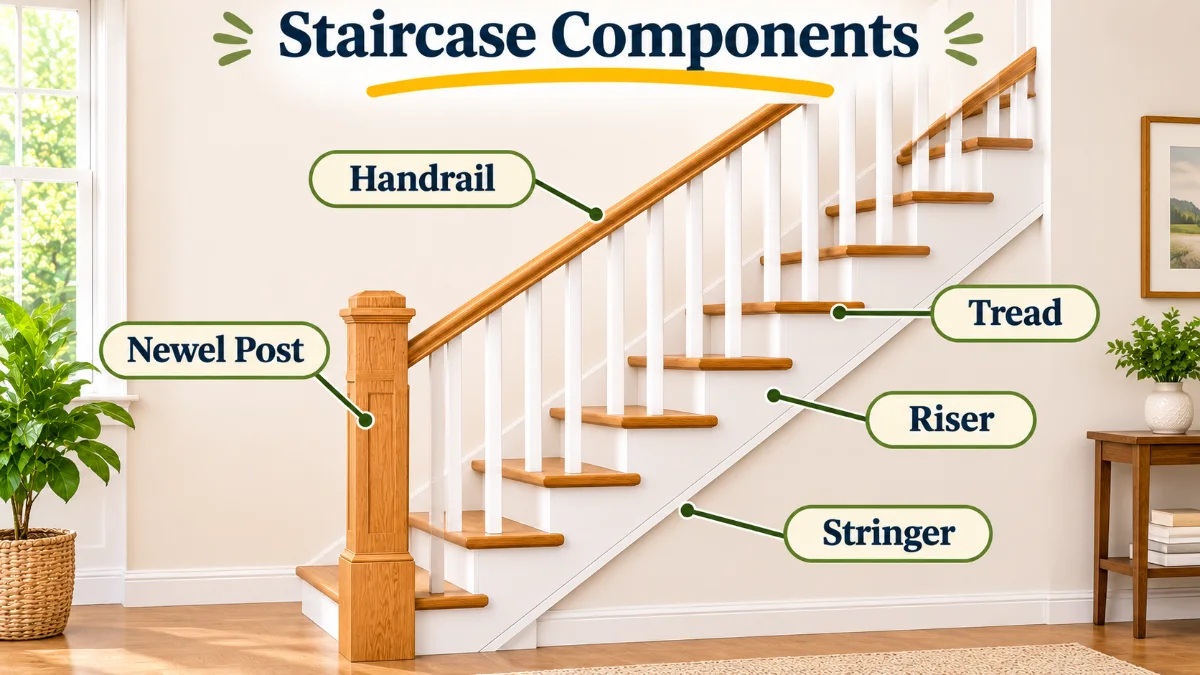
| Part | What it is | Where it sits |
|---|---|---|
| Tread | Flat surface you step on | Horizontal, each step |
| Riser | Vertical piece between treads | Behind each tread |
| Nosing | Front edge of the tread | Overhangs the riser |
| Stringer | Support board that holds treads and risers | Side or underneath |
| Handrail | Rail you grip | Above the balusters or on a wall |
| Baluster (spindle) | Vertical bar under the handrail | Between handrail and base rail or stair |
| Newel post | Heavy post anchoring the rail | Start, end and turns |
| Landing | Flat platform | Top, bottom or mid-flight |
Step Parts: Tread, Riser and Nosing
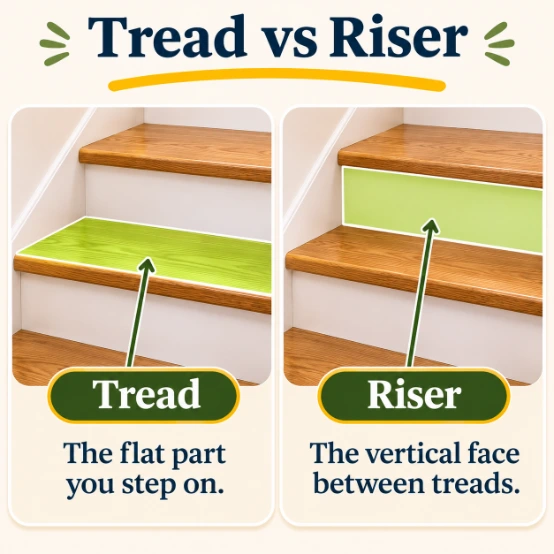
Tread. The tread is the horizontal part of a step, the flat part you stand on. Lapeyre Stair, a division of Laitram, measures it from the front edge back to the riser. OSHA defines a tread as a horizontal member of a stair, excluding landings and platforms.
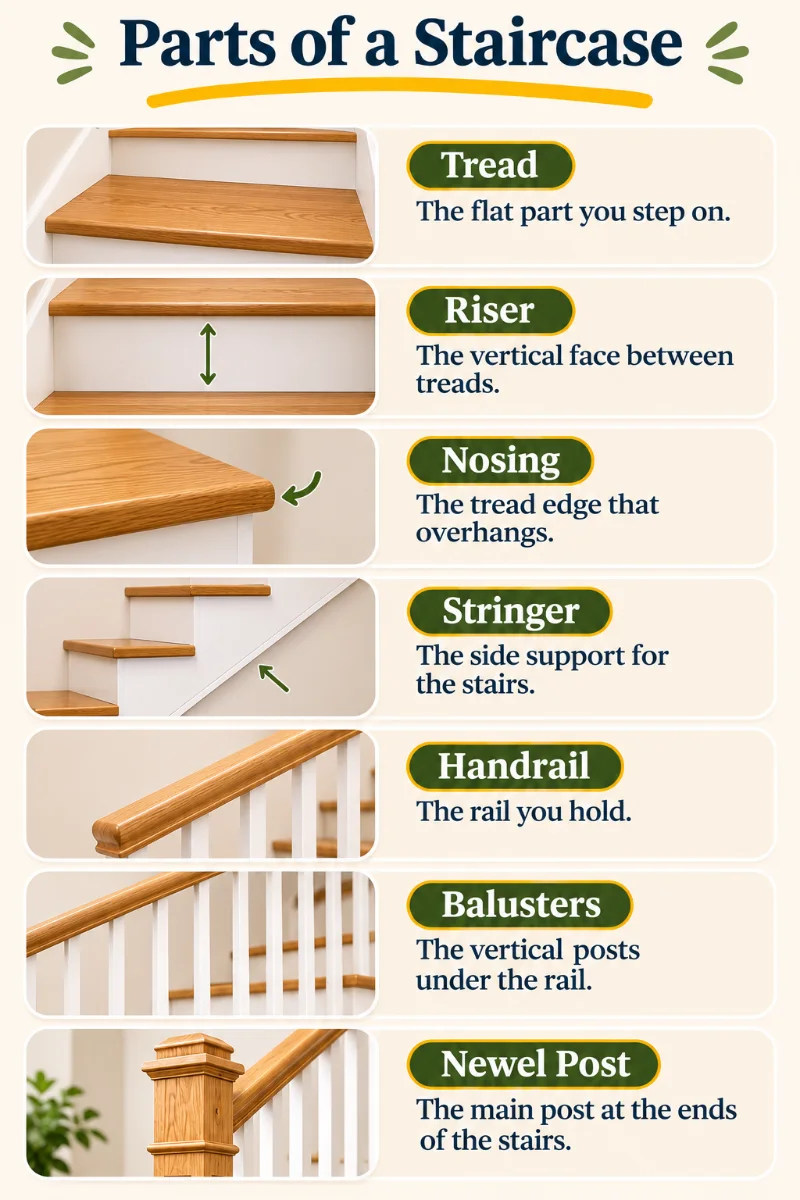
Riser. The riser is the vertical piece between treads. Lapeyre Stair calls stairs with risers closed-tread stairs. The U.S. Government Publishing Office (GovInfo) hosts a 1978 National Bureau of Standards study, Safety on Stairs, which defines a riser as the height of one step, and an open riser as one you can see through. Salisbury Joinery, in a guide by Nat Diffey, describes the riser as closed or open depending on design.
Nosing. The nosing is the front edge of the tread that projects past the riser. Salisbury Joinery notes it makes the step easier to see and less slippery, and it can be a separate strip fixed to the tread.
What Are the Different Types of Staircase Steps?
Step types vary by shape and finish:
- Straight tread: the nosing is straight. Convex tread: the front edge curves and runs between two stringers, according to Specialized Stair and Rail.
- Winder: a pie-shaped or wedge-shaped step used to turn the stairs where a flat landing would normally go.
- Bullnose step: a wider, rounded feature step at the bottom, ending at the newel post. A curtail is a decorative bottom step that curves around the newel, with a larger radius than the bullnose, per Lapeyre Stair.
- Landing: a flat platform that interrupts a run. The GovInfo study describes a landing as a platform larger than a tread and at least 24 inches long.
Stringers and Strings: The Side Supports
The stringer is the support that holds the treads and risers. Parts of stairs differ here in names more than in function:
- Western stringer: also called closed, routered or housed. Treads and risers are routed into the inside face, so from the side it looks like a continuous ribbon.
- Eastern stringer: also called sawtooth or open. It is cut out along the rise and run.
- Mono stringer: a single beam under the centre of the treads, with no risers.
British joinery uses “string.” A closed string staircase hides the step edges. A cut or open string shows the step profile. The wall string is the side that sits flush against the wall, and string capping is the moulding that covers its top. A fascia is a non-structural vertical board on the outside of a staircase or landing.
Where sources disagree: Lapeyre Stair says the stringer runs along each side, and a staircase always has two. H.A. Stiles says it runs along the side or underneath. Specialized Stair and Rail covers the mono stringer, which supports the centre. All three can be right, because each describes a different design.
Railing Parts: Handrail, Baluster, Newel Post and Balustrade
Handrail. OSHA defines a handrail as a rail that gives a handhold. Handrail styles include the mopstick (a traditional round rail), the pig’s ear (a moulded rail fixed directly to a wall), and grooved or ungrooved rails, per Jackson Woodturners.
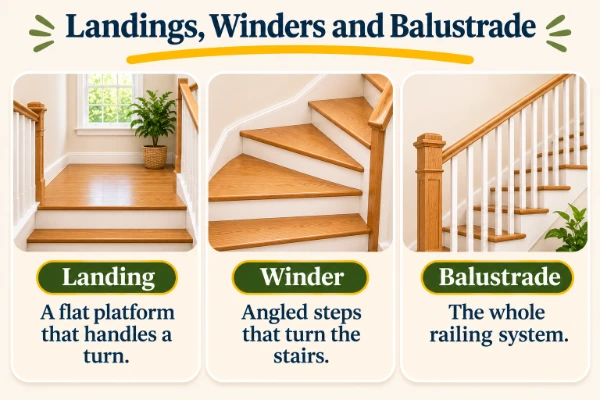
Baluster and spindle. A baluster is a vertical bar between the handrail and the stair or base rail. Spindle is another name for it. H.A. Stiles cites a common code guideline of baluster spacing at or under 4 inches, and advises checking local code.
Newel post. The newel post is the heavy structural post at the start, end or turns of a flight. It anchors the handrail and balustrade. A newel cap or finial tops it, and a half newel is a half-size post used where the stairs meet a wall. Jackson Woodturners also lists pegged newel posts as a newel post type, so ask your supplier for the exact specification. A volute is the spiral end of a handrail at the bottom, used with curtail or bullnose steps, and a gooseneck is the curved handrail section that joins a lower rail to a higher one at a landing or balcony.
Base rail. The base rail is the bottom rail below the balusters.
Guardrail. OSHA treats the stair rail system as a barrier along the open side of stairs, and a guardrail as a separate barrier meant to prevent falls. Lapeyre Stair describes a guardrail as the barrier on an unprotected side.
Balustrade. The balustrade is the whole railing system, and these parts of stairs only work as a set. H.A. Stiles lists handrail, balusters and newel posts, and sometimes the base rail.
Baluster vs Banister: A Naming Disagreement
Lapeyre Stair and H.A. Stiles both call a handrail a banister. Jackson Woodturners, in a guide by Luke Jackson, says “Bannister is often confused with the balustrade… A banister is often seen as all of the handrail parts in general… However, a balustrade is all of the stair parts as a whole.” The safest approach: handrail is the rail you grip, balusters are the bars below it, and balustrade is the full set.
Base rail disagreement: Salisbury Joinery says the base rail sits underneath the balusters and on the string. H.A. Stiles says it is a rail balusters may sit in, especially in modern or closed rail systems. Lapeyre Stair places it above the stringer.
Glass, Brackets and Fixings
Modern balustrades often replace spindles with clear toughened glass, typically 8mm or 10mm thick, held by glass clamps on the base rail and handrail so the glass needs no drilled holes, per Jackson Woodturners. Wall-mounted rails use brackets, and end caps finish the ends of mopstick rails. Cover buttons hide drill holes, cross-grain pellets are tapered plugs matched to the wood, and fixing kits join a handrail to a newel post. Stair cladding is a covering that updates existing stairs without replacement. For more room-by-room ideas, browse our blog home ideas guide.
Stair Code Numbers You Can Check
OSHA defines stairway, tread, riser, handrail and stair rail system but gives no tread or riser dimensions. The numbers below come from the ADA standards published by the U.S. Access Board and apply to accessible stairs.
| Item | ADA requirement |
|---|---|
| Tread depth | 11 inches minimum |
| Riser height | 4 inches minimum, 7 inches maximum |
| Open risers | Not permitted |
| Nosing | Curvature radius 1/2 inch maximum; overhang 1-1/2 inches maximum |
| Handrail height | 34 to 38 inches to the top of the gripping surface |
| Handrail top extension | 12 inches horizontal above the landing |
| Handrail continuity | Continuous along each flight |
The GovInfo study cites a recommended 7-inch riser with an 11-inch tread. Home codes can differ from the ADA, so check local code before changing any stair part.
Measurement Terms for Parts of Stairs
- Rise and run: the riser height and the tread depth.
- Going: the horizontal distance between the face of the first and last risers. Jackson Woodturners says each domestic step’s going should be at least 220 mm.
- Pitch: the angle of the stairs from the horizontal. Rake is Jackson’s word for the pitch of the stairs.
- Diminishing: where a handrail meets the underside of a ceiling line, so the spindles are cut shorter.
- Winder: a tread wider on one side than the other, per the GovInfo study.
British Standard BS 6100 is a glossary of building terms covering stairs, indexed by New Zealand Building Performance on Building CodeHub. The Washington State Department of Labor and Industries also publishes workplace rules on stairs and stair rails.
What Are the Three Types of Stairs?
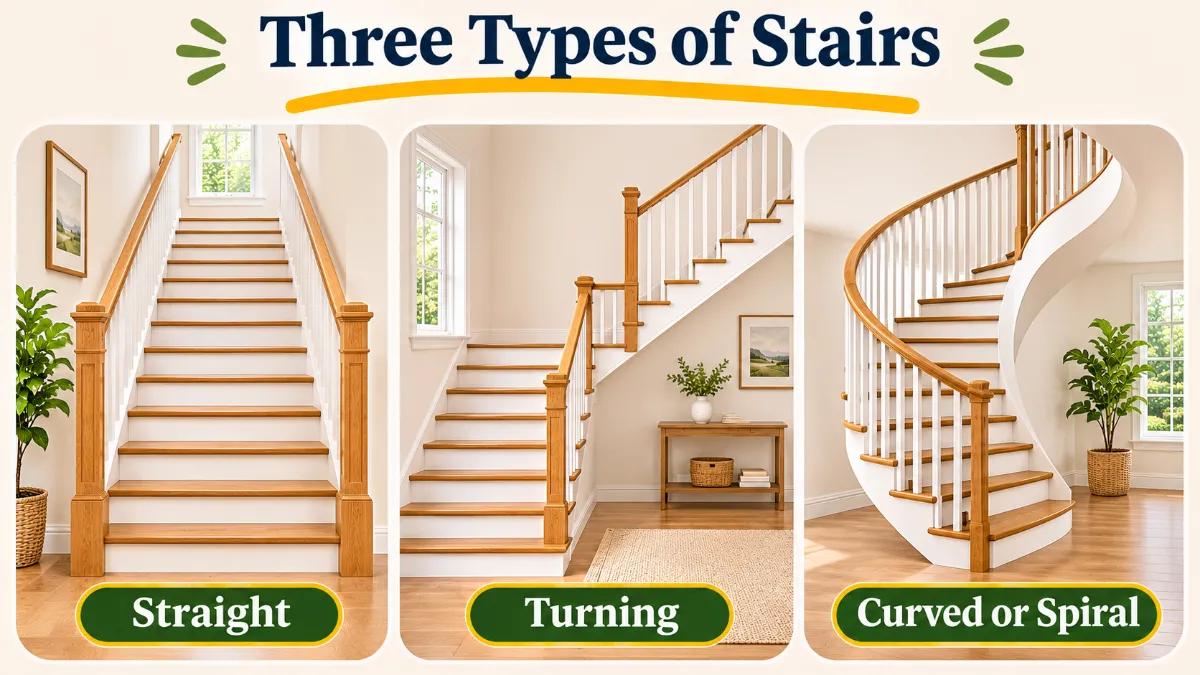
This is the common layout grouping, not a definition from a cited source: straight, turning (L-shaped or U-shaped, using a landing or winders) and curved or spiral.
Final Thoughts
Learn the parts of stairs in three groups: steps (tread, riser, nosing), supports (stringers and strings) and the railing (handrail, balusters, newel posts). Use the names above when ordering replacements, and check local code before changing rail heights or spacing. If you are painting the walls around a staircase, our guides to Neutral Ground and Edgecomb Gray show how each reads in different light.
Frequently Asked Questions
What are the parts of stairs called?
Tread, riser, nosing, stringer, handrail, balusters, newel posts, landing and balustrade. Together they form the staircase.
What are the main parts of a staircase?
Treads and risers form the steps, stringers support them, and the handrail, balusters and newel posts form the railing. Landings handle turns.
What do you call each step of a stair?
Each step is a tread and a riser. The tread is the flat part, the riser is the vertical face, and the nosing is the overhanging edge.
What are some common terms used to describe the parts of a staircase?
Tread, riser, nosing, stringer, handrail, baluster, newel post, balustrade, landing, winder, bullnose, curtail, volute, gooseneck and finial.
What is a baluster vs banister?
A baluster is a vertical bar under the handrail, also called a spindle. A banister usually means the handrail, though some use it for the whole railing.
What do you call the side part of a staircase?
The stringer, called a string in British usage. A wall string sits against the wall and an outer string faces open space.
What are the three types of stairs?
By common layout grouping, not a cited definition: straight, turning (L-shaped or U-shaped) and curved or spiral.
What is the flat part of a step called?
The tread. It is the horizontal surface you step on, and its front edge is the nosing.
What are the different types of staircase steps?
Straight and convex treads, winders, bullnose and curtail steps, and landings.
What are the columns in stairs called?
Newel posts are the thick columns at the start, end and turns. Balusters or spindles are the thin vertical bars along the rail.