Frameless Cabinets: What They Are, Pros, Cons and Cost
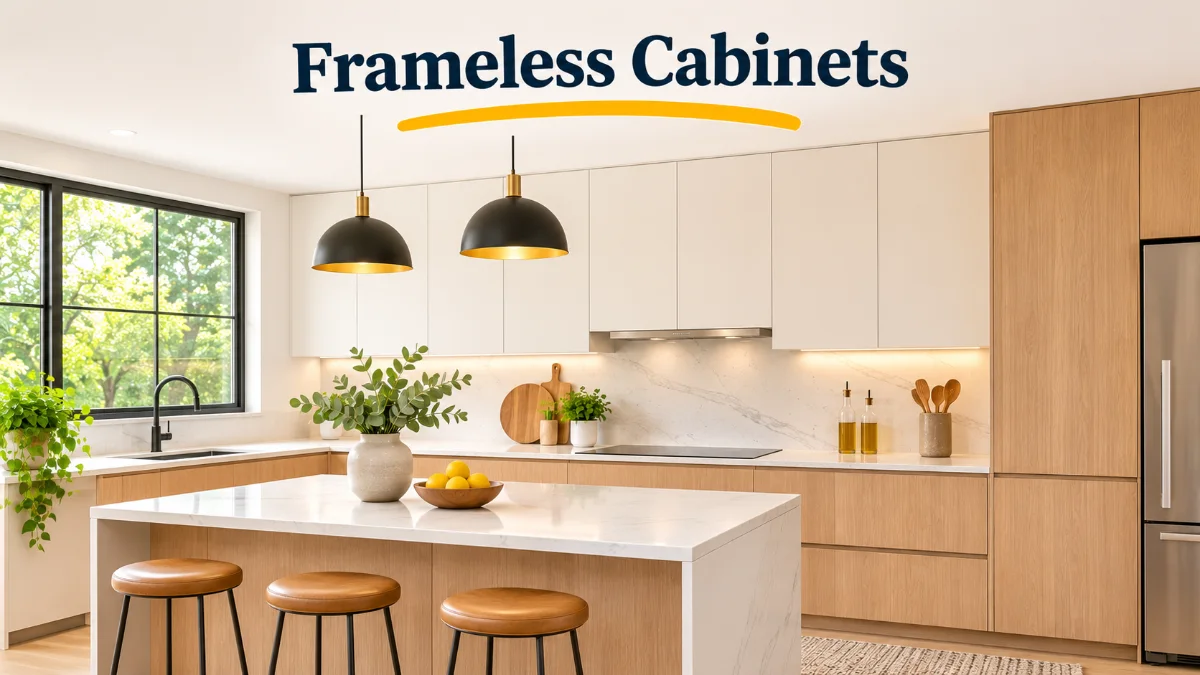
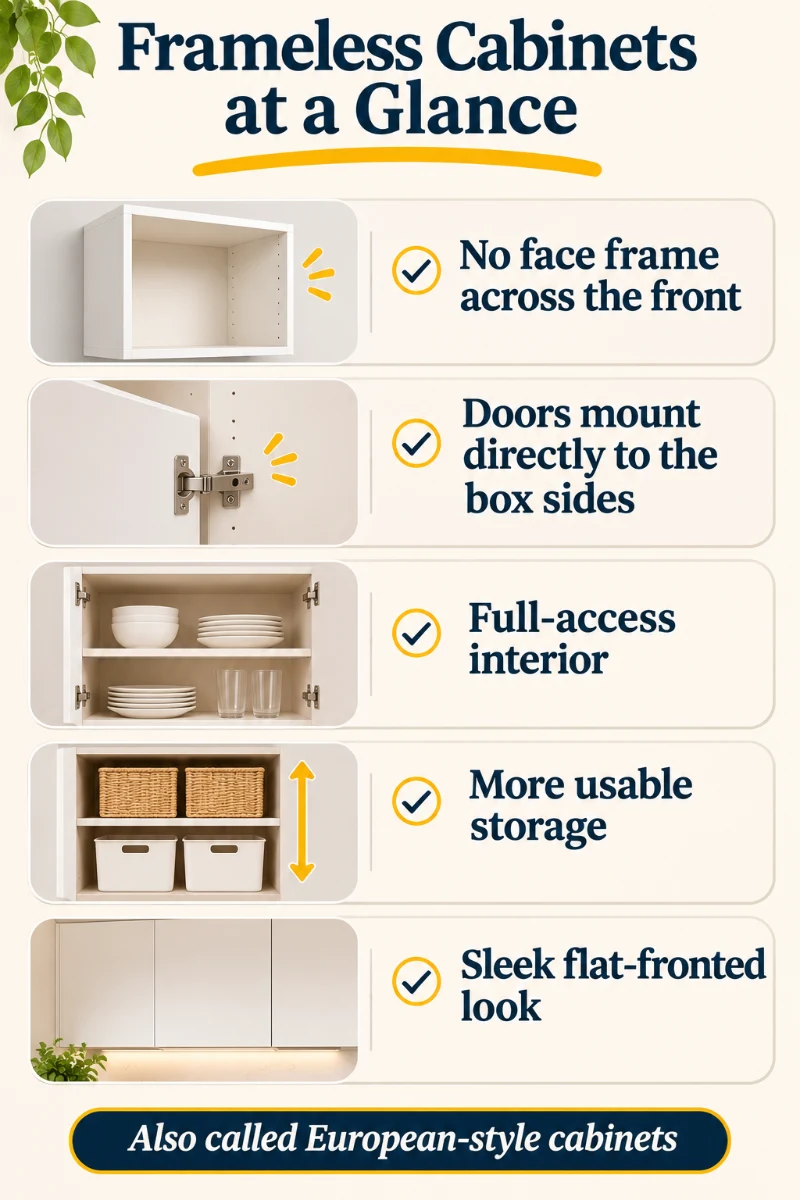
Frameless cabinets are boxes with no face frame across the front, so the doors mount directly to the sides of the box and the whole opening stays clear. That is why they are also called full-access or European-style cabinets. The trade-off is simple: you get more usable storage and a sleek, flat-fronted look, but you need fairly straight walls, careful installation and a sturdy box. Framed cabinets keep a wood frame about 1-1/2 inches wide on the front, which adds rigidity and forgives uneven walls.
Choose frameless for storage, modern or minimalist design and small kitchens. Choose framed for older homes with out-of-square walls, traditional looks or inset doors. This guide covers construction, pros and cons, fillers, hinges, installation and cost, with notes where sources disagree.
Frameless vs Framed Cabinets at a Glance
| Feature | Frameless | Framed (face frame) |
|---|---|---|
| Front of the box | No frame; doors mount to the side panels | Wood frame of rails and stiles, about 1-1/2 inches wide |
| Door styles | Full overlay only | Standard (partial) overlay, full overlay or inset |
| Opening | Fully clear, no center stile | Narrowed by the frame; a center stile may split wide doors |
| Look | Sleek, flush, modern | Traditional, with visible frame or reveals |
| Walls that are not square | Less forgiving | More forgiving |
| Hinge anchor | Side panel of the box | Wood frame |
What Does Frameless Cabinetry Mean?
Frameless cabinetry is a European construction method that has become popular with American homeowners who want simpler, more contemporary designs. MasterBrand Cabinets describes it as sometimes called “full access” because removing the face frame gives greater accessibility. Showplace Cabinetry uses the same terms, full access and European style.
Without a frame, the box has to do the structural work. Frameless boxes rely on thicker sides, floors and backs for strength. The doors cover the entire box front, which means only full overlay doors work, and hinges attach directly to the inside of the side panels. Because the door and drawer fronts sit edge to edge, the result is a smooth, uniform finish.
Bellmont Cabinet Co. builds its made-to-order cabinets in the European frameless style in the United States. Wellborn Cabinet sells a full-access frameless line called Aspire, and Medallion Cabinetry offers a frameless line that uses the same doors and finishes as its framed line, so you can switch between them.
What Are Framed Cabinets?
Framed cabinets are the traditional American method. Rails (the horizontal pieces) and stiles (the vertical pieces) form a face frame on the front of the box, usually about 1-1/2 inches wide. The Kitchen Cabinet Manufacturers Association, known as KCMA, gives the same width and a frame thickness of 3/4 inch. Doors and drawers attach to this frame, and hinges screw into it.
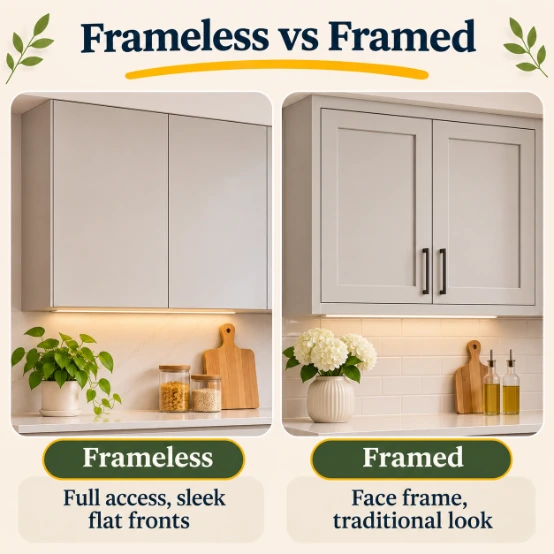
The frame keeps the box square, gives hinges solid wood to grip and provides a good place to join neighboring cabinets. Its downsides are a narrower opening, slightly less interior space and, on wide double doors, a center stile that splits the opening.
The Three Framed Door Styles
Framed cabinets come with three door styles, which differ in how much of the frame you see.
- Standard (partial) overlay: about 1 to 1-1/2 inches of frame shows between doors. It is traditional and the most forgiving.
- Full overlay: the doors cover most of the frame, leaving a narrow, even reveal. It looks flush and modern.
- Inset: the door sits flush inside the frame. It looks tailored but is the most demanding to build and fit, and it is the premium option.
Inset cabinets are a type of framed cabinet, so they are not the same as frameless. Overlay describes how a door sits over the opening and applies to both framed and frameless construction, although frameless always uses full overlay.
How Can You Tell Which Type You Have?
Open a door. A flat wooden border around the opening means the cabinet is framed. If you see only the raw edge of the side panel, it is frameless. You can also check the hinge: on framed cabinets it screws into the wood border, and on frameless cabinets it screws into the inside face of the side panel. This matters when you replace parts, because framed and frameless hinges are not interchangeable.
What Are the Advantages of Frameless Cabinets?
The advantages of frameless cabinets come from removing the frame.
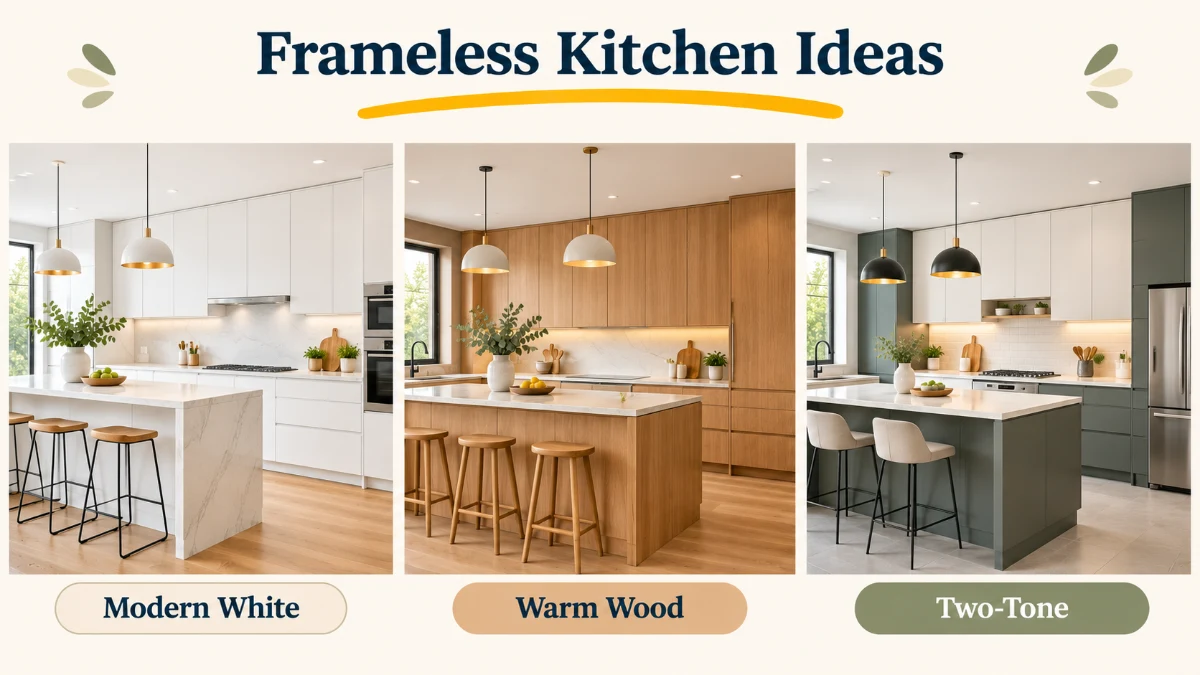
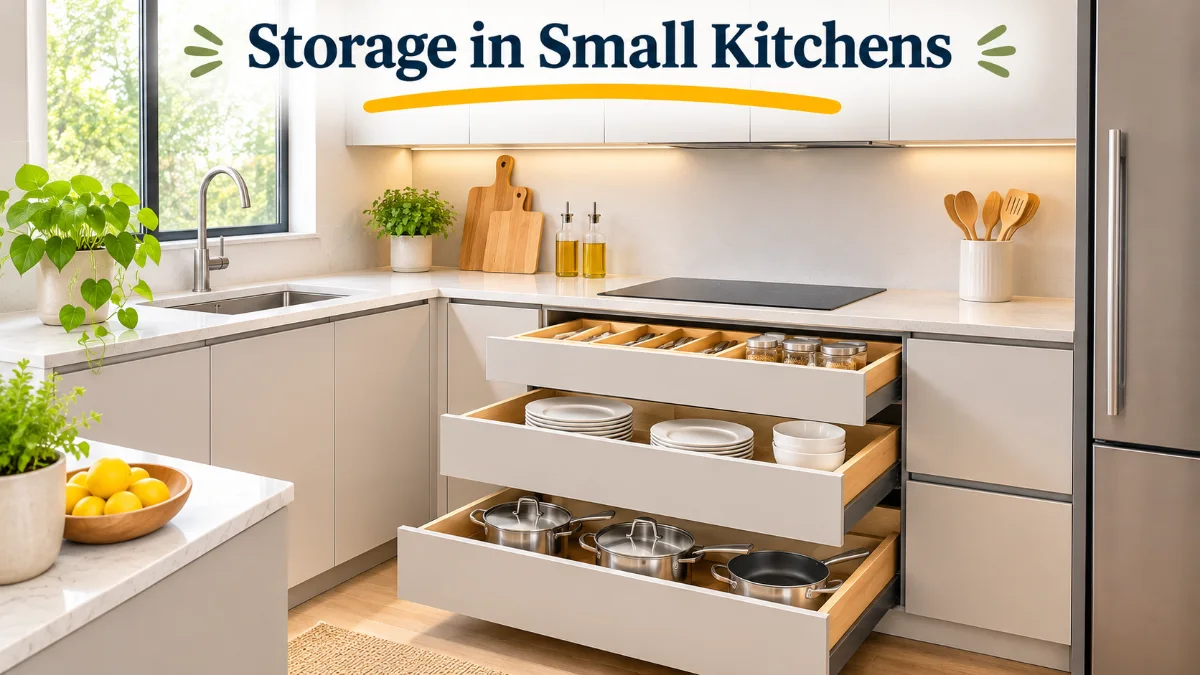
- More storage: openings are about 1.5 inches wider than the same cabinet with a frame, drawers can be larger, and roll-out trays and pantry pull-outs fit more easily.
- Easier access: you can see and reach the whole interior, dishes do not catch on a frame, and there is no center stile between paired doors.
- Easier shelf adjustment: nothing sits in the way when you move shelves, and doors can be left off for open shelving.
- Easier cleaning: smooth surfaces leave fewer ledges where crumbs and dirt collect.
- Design flexibility: the look is best known as sleek, modern and minimalist, but Bishop Cabinets shows it working in a white oak shaker kitchen as well.
- Efficient use of space: the saved inches matter most in small kitchens.
How Much More Storage Do You Really Get?
Sources give different numbers. Bishop Cabinets says the difference can be as much as 15% in favor of frameless. KCMA says about 20% more storage with full access. Lily Ann Cabinets declines to give one figure, arguing it depends on cabinet width, frame width and drawer hardware. The gain is real but largest in drawers and wide base cabinets, and smaller in wall cabinets.
Showplace Cabinetry makes a practical point about roll trays. In framed cabinets they mount to vertical pilasters so they clear the doors. In a single-door frameless cabinet, the tray mounts to the cabinet side, with spacers on the hinge side to clear the door, so it holds more.
What Are the Downsides of Going Frameless?
The drawbacks are mostly about precision and design limits.
- Tight tolerances: with no frame to hide imperfections, the boxes must be level and square, and poor installation or manufacturing shows. Gaps between doors reveal wall irregularities.
- Higher skill needed: Bishop Cabinets and George Cabinetry both say frameless is best left to experienced installers.
- Design limits: angled and offset cabinets are unavailable or hard to do in frameless, and angled doors can look poor, especially on white finishes, because of shadowing where the door meets the cabinet side. A truly traditional look is harder to achieve.
- Hinge dependence: hinge quality matters more because hinges anchor into the side panel. George Cabinetry notes the hinge choices are limited.
- Fillers and sizing: Showplace Cabinetry says sizing and customization can be limited and more fillers may be needed (see the filler section below).
Is a Frameless Box Less Sturdy?
Not if they are built well. KCMA says a properly built frameless cabinet is equally durable as a framed one, because the thicker box replaces the frame. George Cabinetry says cheaper versions can feel less solid, and Showplace Cabinetry says structural integrity is maintained without a frame.
The difference is in the box. Bishop Cabinets warns that some makers use 5/8 inch box ends and 1/4 inch backs, which can cause durability problems. It advises looking for 3/4 inch sides and ideally a 1/2 inch back. Medallion Cabinetry’s frameless line uses 3/4 inch construction, with laminated furniture board as standard and all-plywood as the upgrade.
Lily Ann Cabinets lists plywood boxes as costing more than particleboard. Ask what the box is made of, how thick it is, and whether the line is tested and certified by KCMA. KCMA’s A161.1 certification tests structural integrity, moisture resistance, hardware performance and finish durability. The Woodwork Institute and AWMAC jointly publish the North American Architectural Woodwork Standards (NAAWS), a reference for architects and millwork firms. Its public page does not compare framed and frameless, so it is no verdict on either.
Do Frameless Kitchen Cabinets Need Fillers?
Often, yes, but not because the cabinets are frameless. Fillers are strips that fill gaps between a cabinet and a wall or between cabinets. They serve a few jobs in any kitchen:
- they space doors and drawers so they can open where they would hit a wall;
- they keep hardware from bumping together at corners;
- they cover gaps left by shims when walls or floors are uneven.
Sources split on whether frameless needs more or fewer. Showplace Cabinetry says more fillers may be needed because sizing is limited. George Cabinetry says there may be savings from fewer filler panels and more usable storage. Both can be true depending on the layout, so have your designer show every filler on the drawing before you order. For more room-by-room ideas, browse our blog home ideas guide.
Which Is Better, Frameless or Framed Cabinets?
Neither wins in every kitchen. Let the room, walls and style decide.
| If you want | Lean toward |
|---|---|
| Maximum drawer and shelf space | Frameless |
| A small kitchen that feels open | Frameless |
| A modern, minimalist or slab-door look | Frameless |
| An older home with uneven walls | Framed |
| A traditional, farmhouse or coastal look | Framed |
| Furniture-style flush doors | Framed, inset |
| A first-time DIY installer | Framed |
George Cabinetry adds that framed holds up well in high-traffic homes with children, and frameless suits frequent cooks with bulky appliances. A full overlay framed cabinet can also give a flat look while tolerating uneven walls.
What Are the Three Types of Cabinets?
The answer depends on what is being sorted. By construction, kitchen cabinets are usually framed, frameless and inset, though inset is really a framed door style. By grade, they are stock, semi-custom and custom. By position, they are base, wall and tall cabinets. For a frameless purchase, the construction type and the grade matter most.
Hinges, Slides and Drawers
Frameless doors use concealed, adjustable hinges that mount inside the side panel. Blum, a hardware maker, offers concealed hinges such as the CLIP top, with integrated BLUMOTION soft-close available. Blum also lists COMPACT hinges aimed at face frame cabinets, which shows why hinges are not interchangeable between the two types. Both types use hinges that adjust in three directions, according to Lily Ann Cabinets.
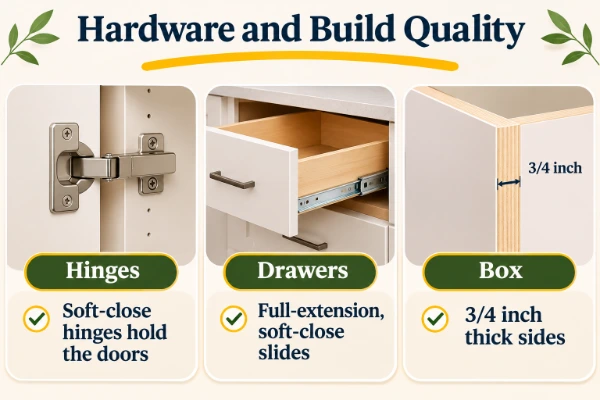
If a door sags or a gap looks uneven, hinge adjustment is the first fix. George Cabinetry says frameless hinges may need periodic adjustment in humid conditions or with heavy use. Framed hinges anchor into hardwood, so stripped screws are easier to repair, while frameless hinges anchor into engineered panel, where repair is still possible.
For drawers, look for full-extension slides, soft-close and dovetail drawer boxes. Lily Ann Cabinets lists these among the features that raise cost. Medallion Cabinetry offers heavy-duty Quiet Close drawers with 135 pounds of capacity as an upgrade.
How Do You Install a Frameless Cabinet?
Following the steps used by MasterBrand Cabinets:
- Level and align: level each cabinet and line it up with its neighbors.
- Hang on a suspension rail: fasten a suspension rail to the wall studs. The rail carries the weight of the cabinets and keeps the run level.
- Fix the boxes: attach each cabinet to the rail with screws through the back or with brackets on the sides.
- Add hinges and doors: mount the hinges to the sides of the box, then hang the doors.
Framed cabinets go in differently: align the face frames, screw the cabinets to the studs, level and secure each frame, then add hinges and doors. That is more forgiving on out-of-square walls because stiles and fillers cover gaps. Frameless needs level, square boxes, though applied end panels can hide gaps against uneven walls.
Which Is Cheaper, Framed or Frameless?
Sources disagree, so there is no single answer.
- Angi says framed cabinets cost about $500 less per cabinet than frameless, and are typically cheaper when materials and design are equal.
- George Cabinetry, in a guide by senior project manager Raymond, says framed is usually cheaper in standard or semi-custom lines and frameless often has a higher base cost.
- KCMA says the two have very similar linear-foot pricing.
- Showplace Cabinetry says skipping the frame simplifies manufacturing and lowers production costs.
- Bray & Scarff, a Virginia and Maryland appliance and kitchen retailer, lists a higher upfront cost for frameless.
The common thread is that the price gap within one brand and material is smaller than the effect of other choices. Lily Ann Cabinets says door style and finish are the biggest factors, followed by box material (plywood costs more than particleboard), drawer construction, inset versus overlay (inset is the clearest premium), and assembled versus ready-to-assemble (RTA) cabinets, which ship flat and cost less to deliver.
How Much Do Frameless Cabinets Typically Cost?
Most kitchen cabinets run about $100 to $300 per linear foot, according to Angi and Fixr, and fully custom or luxury lines can reach $500 per linear foot. A standard kitchen has roughly 25 to 40 linear feet of cabinets, which Fixr puts at about $2,500 to $12,000 in total, or $12,000 to $20,000 for luxury custom work. None of the sources gives a separate price range for frameless alone. Treat these as ballpark figures for any cabinet type, and get quotes for your layout, because installation costs about the same for both types according to Angi.
What Are the Best Frameless Kitchen Cabinets?
No source ranks makers, so the best choice depends on your budget and quality needs. Compare lines on these points:
- box thickness of 3/4 inch, and plywood versus furniture board;
- a back that is 1/2 inch rather than 1/4 inch where possible;
- soft-close hinges and full-extension, soft-close drawers;
- KCMA certification;
- the finishes and door styles you want.
Frameless makers worth comparing include Bellmont Cabinet Co. (made-to-order, built in the United States), Medallion Cabinetry, Wellborn Cabinet and Bishop Cabinets, which offers white oak shaker and melamine styles. Other names you will meet while shopping include AristoKraft, Diamond, Decora, Dura Supreme, Fieldstone, Homecrest, Kemper, KitchenCraft, Mantra, Mid Continent, Omega, Schrock, Shenandoah, StarMark, Thomasville, Timberlake, UltraCraft, Urban Effects, Waypoint and Wood-Mode. Sellers include RTA Cabinet Supply, Domain Cabinets, MKE Cabinetry, Blue Valley Cabinets, Kitchenview Custom Cabinets, Best Online Cabinets, HomeCabinets, Kitchen Cabinet Kings and Express Kitchens. A door name tells you the style, not the box. Lily Decker, a former sales and marketing manager at Lily Ann Cabinets, writes that Lily Ann’s lines are framed, including Colorado White Shaker, White Shaker Elite, Grey Shaker Elite and Craftsman Natural Shaker. Whether any line is framed, frameless or both varies, so check each construction sheet.
Final Thoughts
Frameless cabinets earn their place when storage, access and a clean modern look matter most, and when your walls and installer can deliver square, level boxes. Pick a thick, certified box, good hinges and soft-close drawers, and plan fillers before ordering. With uneven walls or a traditional or inset look, framed is safer. If you are choosing a cabinet finish, our color guides show how Edgecomb Gray, a warm greige, and Vintage Vogue, a smoky deep green, look on kitchen cabinets.
Frequently Asked Questions
What are the downsides of frameless cabinets?
They need precise installation, are less forgiving on uneven walls, limit door styles to full overlay, make angled cabinets hard, and depend on strong hinges and a thick box.
What does frameless cabinetry mean?
It means cabinets built without a face frame. Doors mount to the side panels, so the opening is fully accessible. It is also called full-access or European-style construction.
Which is cheaper, framed or frameless cabinets?
Sources disagree. Angi says framed costs about $500 less per cabinet, while KCMA says linear-foot pricing is very similar. Door style, finish and box material affect price more.
What is better, frameless or framed cabinets?
Frameless is better for storage, small kitchens and modern design. Framed is better for uneven walls, traditional looks, inset doors and first-time installers.
Are frameless cabinets less sturdy?
Not when well built. KCMA says a properly built frameless cabinet is equally durable. Look for 3/4 inch sides, a 1/2 inch back, plywood if possible and KCMA certification.
What are the three types of cabinets?
By construction: framed, frameless and inset (a framed door style). By grade: stock, semi-custom and custom. By position: base, wall and tall.
Do frameless cabinets need fillers?
Often, at walls, corners and uneven spots, to give doors and drawers clearance and cover gaps. Plan every filler with your designer before ordering.
What are the best frameless kitchen cabinets?
The best have 3/4 inch plywood or furniture-board boxes, soft-close hinges, full-extension drawers and KCMA certification. Compare Bellmont, Medallion, Wellborn and Bishop lines.
What are the advantages of frameless cabinets?
More usable storage, wider openings, larger drawers, no center stile, easier cleaning and a sleek modern look that suits small kitchens.
How much do frameless cabinets typically cost?
Most kitchen cabinets run $100 to $300 per linear foot, with custom up to $500. No source gives a frameless-only range, so get quotes.