Bathroom Ceiling Paint: Best Picks, Finishes and How to Apply It
Introduction
Quick answer: The best bathroom ceiling paint is a water-based acrylic latex paint with a built-in mildew-resistant film. Choose satin or semi-gloss if your bathroom has a steamy shower or weak ventilation. Choose a mildew-resistant flat or matte ceiling paint if the room has a strong exhaust fan and you want a smooth, glare-free look. Zinsser Perma-White, Benjamin Moore Aura Bath and Spa, Benjamin Moore Waterborne Ceiling Paint and Sherwin Williams Premium Ceiling Paint are the strongest manufacturer-backed options, and each one is covered below with its verified specs.
A bathroom ceiling takes more abuse than any other ceiling in the house. Hot steam rises, hits a cooler surface and condenses, so the paint is wet again and again. Standard flat ceiling paint was never designed for that, and it often starts to bubble, peel or grow black spots within a year or two.
This guide explains which bathroom ceiling paint to buy, which finish to pick, how each top product compares, how to match paint to your type of bathroom, and how to apply it so it lasts. You will also find short, direct answers to the ten questions people ask most.
What Is the Best Ceiling Paint for Bathroom Use?
There is no single winner for every room, because the right choice depends on how much steam the room makes and how well it vents. Use this table as a starting point.
| Your situation | Best fit | Finish |
|---|---|---|
| Steamy shower, little ventilation | Zinsser Perma-White Mold and Mildew-Proof | Satin, semi-gloss or eggshell |
| Premium paint for a bathroom ceiling and walls | Benjamin Moore Aura Bath and Spa | Matte |
| Ceiling-only product with a bathroom ceiling listed | Benjamin Moore Waterborne Ceiling Paint | Ultra flat |
| Self-priming, mold and mildew resistant ceiling coat | Sherwin Williams Premium Ceiling Paint | Flat |
| Ceiling and walls in one durable paint and primer | Sherwin Williams Emerald Interior Acrylic Latex | Flat, matte, satin or semi-gloss |
| Dry, well-ventilated half bath on a budget | BEHR Premium Plus Interior Ceiling Paint | Flat |
Whichever bathroom ceiling paint you choose, remember the rule that matters most: paint cannot fix a moisture problem. A strong exhaust fan, a sound ceiling and the right prep do as much work as the can does.
Why Do Bathrooms and Their Ceilings Need Special Paint?
Bathrooms combine heat, water vapor and poor air movement. The ceiling is the coldest, highest surface, so steam condenses there first. A normal ceiling coat is porous and absorbs that moisture, which weakens its grip on the surface.
The US Environmental Protection Agency says moisture control is the key to mold control. It advises keeping indoor relative humidity below 60 percent, ideally between 30 and 50 percent, and drying wet areas within 24 to 48 hours. A bathroom can pass both limits in a single shower, which is why the paint has to tolerate repeated wetting.
The Real Challenges
- Steam and humidity: every hot shower raises the moisture level in the room.
- Condensation: water droplets form on the cool ceiling and sit on the paint film.
- Temperature swings: repeated heating and cooling stress the coating.
- Limited airflow: without ventilation, moisture lingers for hours.
- Soap residue and body oils: organic buildup gives mold something to feed on.
What Happens When You Use the Wrong Paint
- Peeling: the film loses adhesion and lifts in sheets, often starting above the shower.
- Bubbling: trapped moisture pushes the coating away from the surface.
- Cracking: the dried film becomes brittle and splits along joints.
- Staining and dark spots: mildew grows on the surface and shows through.
- Frequent repainting: you repeat the job every year or two.
A Cautionary Tale: The Peeling Shower Ceiling
Here is a common failure pattern. A homeowner covers a bathroom ceiling with leftover flat ceiling paint, skips the primer and runs the fan only occasionally. Within a season, paint blisters directly over the shower, then flakes onto the floor. Underneath, the surface is chalky and stained. The cure is never another coat on top. It means scraping the loose film, cleaning the surface, priming with a moisture-resistant primer and repainting with a bathroom-rated product. Starting correctly costs less than fixing the failure.
Different Types of Paint for Bathroom Ceilings
Acrylic Latex Bathroom Ceiling Paint
Acrylic latex is the standard choice, and for good reason. It is water-based, so it dries quickly, has lower odor and cleans up with soap and water. It stays flexible as the ceiling expands and contracts, and it resists yellowing better than oil. Nearly every product recommended in this guide is an acrylic or latex formula.
Water-Based Paint
Water-based paint is the broader category that acrylic latex belongs to. Modern water-based formulas now match the toughness of older oil paints, with far fewer fumes and much easier cleanup. For a ceiling, where you work overhead and breathe the vapors, that low odor matters.
Mold Resistant Bathroom Ceiling Paint
Mildew-resistant paints contain additives that help prevent mildew from growing on the paint film itself. You will see the claim worded two ways: “mold and mildew resistant” or “mildew resistant.” Read it carefully. These coatings protect the dried paint surface. They do not stop moisture from reaching a wet or leaking ceiling, and they do not remove mold that is already growing underneath. Clean and dry the surface first.
Bathroom-Specific Paint Formulas
Several brands make paint designed for baths, such as Benjamin Moore Aura Bath and Spa and Zinsser Perma-White. These combine moisture resistance, mildew protection and a washable film. They cost more than basic ceiling paint, but they are built for the exact conditions in a shower room.
Oil-Based Paint
Oil-based paint creates a hard, moisture-resistant film, but it has real drawbacks on a ceiling. It has strong odor, dries slowly, needs mineral spirits for cleanup and tends to yellow over time, especially in white. Water-based paint has largely replaced it for ceilings, and oil is best reserved for specific jobs such as sealing a stained area under primer.
Choosing the Right Finish: Bathroom Ceiling Paint Satin vs Semi-Gloss
Sheen controls how well the paint resists water, how easy it is to wipe and how much it shows imperfections. Higher sheen means a tighter, more washable film. It also means more reflected light, so every dent and roller mark shows.
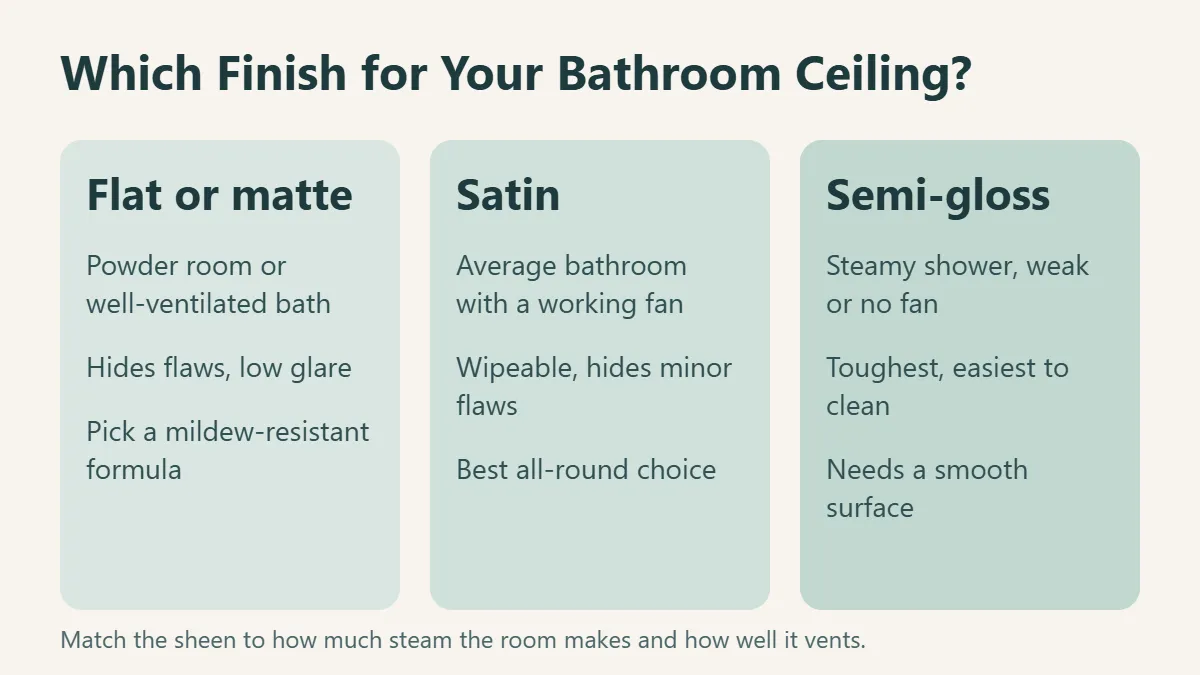
Flat Finish and Matte Finish
Flat and matte finishes hide surface flaws and reduce glare, which is why ceilings are usually flat. Plain flat paint is porous and not ideal for bathrooms. However, a flat or matte product that is formulated for baths, such as Benjamin Moore Waterborne Ceiling Paint (ultra flat) or Aura Bath and Spa (matte), is a different story. These carry a mildew-resistant claim and suit a well-ventilated room.
Satin Finish
Satin has a soft glow and a moisture-resistant, wipeable film. It hides minor flaws better than semi-gloss, so it is the best all-round compromise for a typical bathroom ceiling.
Semi-Gloss Finish
Semi-gloss is the toughest and easiest to clean. It sheds water best, so it suits steamy shower ceilings and bathrooms with poor ventilation. The trade-off is that it highlights uneven drywall, patches and roller marks, so the surface must be smooth.
What Works Best
| Bathroom conditions | Finish to choose |
|---|---|
| Steamy shower, weak or no fan | Semi-gloss |
| Average bathroom with a working fan | Satin |
| Powder room or half bath with no shower | Flat or matte, if mildew resistant |
| Ceiling with texture or imperfections | Satin, or a mildew-resistant flat |
Manufacturers do not all agree here. Benjamin Moore and Sherwin Williams both market flat ceiling products with mildew resistance for bathroom ceilings, while many painting guides push semi-gloss only. Both approaches work. Use gloss for moisture severity and flat for flaw hiding, and always match the choice to your ventilation.
Key Features to Look For Before You Buy
Moisture Resistance
A moisture resistant bathroom ceiling paint should resist water absorption and not soften when wet. Look for products that name bathrooms or high-humidity rooms on the label.
Mildew Resistance
Check that the label says mildew resistant or mold and mildew resistant. Without this, the paint can become a food source for mildew in damp corners.
Adhesion and Primer Performance
Good adhesion keeps the paint from lifting. Self-priming products reduce steps, but a separate moisture-resistant primer is wise over stains, bare drywall or previous peeling.
Washability and Durability
You will need to wipe soap film and splash marks. A washable, scrubbable film survives cleaning. Check the manufacturer’s wait time before you wash a fresh coat.
Low VOC and Odor
Volatile organic compounds, or VOCs, are the fumes released while paint dries. In a closed bathroom you want low VOC and low odor. Benjamin Moore lists Waterborne Ceiling Paint under 50 g/L, and Sherwin Williams Premium Ceiling Paint carries GREENGUARD certification for low chemical emissions.
Coverage and Drying Time
Coverage tells you how much to buy, and drying time tells you how fast you can recoat. The product comparison below shows the numbers published by each manufacturer.
Best Paint for Bathroom Ceilings: Top Recommendations
Benjamin Moore Aura Bath and Spa Ceiling and Wall Paint
Benjamin Moore Aura Bath and Spa is a matte, waterborne acrylic paint made for bathrooms. The official page says it provides a mildew-resistant coating, resists humidity and is low VOC. It covers 350 to 400 square feet per gallon, with two coats recommended, and is dry to the touch in one hour with a one-hour recoat time. It is interior only, comes in more than 3,500 colors and cleans up with soap and water.
The product page lists residential bathrooms and commercial bathroom ceilings as intended uses. It is a premium bathroom ceiling paint if you want matching color on the walls and ceiling with a velvety, low-glare look.
Benjamin Moore Waterborne Ceiling Paint
Benjamin Moore Waterborne Ceiling Paint is an ultra-flat, waterborne ceiling paint. The official page lists bathroom ceiling as a project use and states that it provides a mildew-resistant coating. It has VOC under 50 g/L, covers 400 to 450 square feet per gallon and needs one or two coats. Dry time is one hour, recoat is one to two hours, and it applies by brush, roller or spray between 50 and 90 degrees Fahrenheit.
It is a smart pick for a well-ventilated bathroom where you want a clean white ceiling and minimal spatter and lap marks.
Zinsser Perma-White Mold and Mildew-Proof Paint
Zinsser Perma-White is the most bathroom-focused bathroom ceiling paint on this list. It is a water-based, low-odor interior paint that comes in satin, semi-gloss and eggshell. The manufacturer guarantees the mold and mildew-proof film for five years, and describes it as stain and moisture resistant, washable and scrubbable. It is self-priming, so sanding is not required on a sound surface.
Two instructions from the official page matter for ceilings. If you paint near a shower, wait 24 hours before using it, and do not scrub the paint for seven days. The page does not list VOC, coverage or dry times, so confirm those on the can for your sheen.
Sherwin Williams Premium Ceiling Paint
Sherwin Williams Premium Ceiling Paint is an ultra-flat, white-base ceiling paint. The official page says its Mold and Mildew Resistant Technology helps inhibit mold and mildew growth on the paint film surface. It is self-priming with one-coat coverage, spatter resistant and GREENGUARD certified for low chemical emissions. The page does not publish VOC grams per liter, coverage or dry times, and it does not name bathrooms specifically.
It works well on dry, ventilated bathroom ceilings. For a steam-heavy shower, step up to a higher sheen.
Sherwin Williams Emerald Interior Acrylic Latex
Sherwin Williams Emerald Interior Acrylic Latex is a paint-and-primer product with advanced stain-blocking technology, sold in flat, matte, satin and semi-gloss. It is known for washability and coverage, and it is tintable. The page content we could verify did not state a mildew-resistance claim, VOC or dry times, so confirm bathroom suitability with the data sheet or a Sherwin Williams store before you buy.
Choose it when you want one premium, scrubbable paint for the ceiling and walls, using satin or semi-gloss on the ceiling for a steamy room.
BEHR PREMIUM PLUS Interior Ceiling Paint
BEHR Premium Plus Interior Ceiling Flat Paint and Primer is a low-VOC flat paint that covers 250 to 400 square feet per gallon and is spatter resistant. The official page lists interior ceilings as the use and makes no mildew-resistance or bathroom claim. That makes it a budget option for a dry powder room, not a shower bathroom. If you use it in a bathroom, put a moisture-resistant primer underneath and run the fan faithfully.
Valspar Anti-Rust
Valspar Anti-Rust products are designed to stop rust and corrosion on iron and steel, not to coat ceilings. Valspar’s own metal product page is written for railings, furniture and metal doors. In a bathroom, these paints belong on rusted metal parts, such as a steel access panel, pipe or vent housing, not on the drywall ceiling. Painting the whole ceiling with a metal enamel is a mismatch, because it is not made for moisture control on porous drywall.
Product Comparison
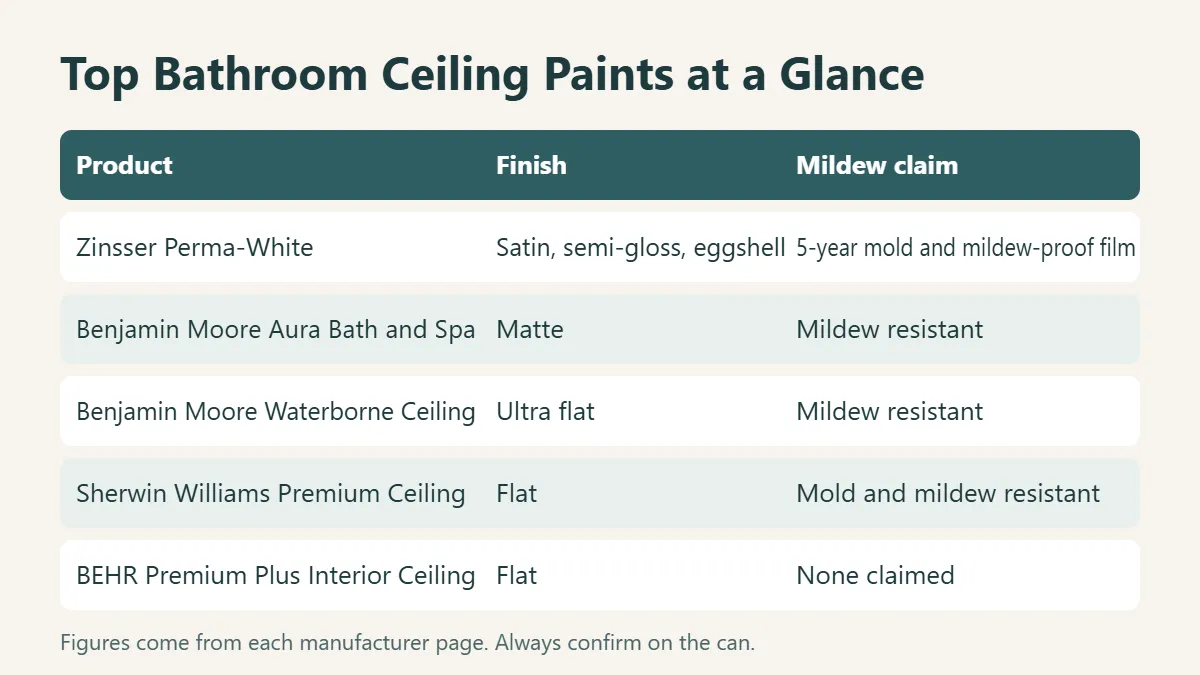
| Product | Finish | Mildew claim | Coverage per gallon | Dry / recoat |
|---|---|---|---|---|
| Benjamin Moore Aura Bath and Spa | Matte | Mildew resistant | 350-400 sq ft | 1 hour / 1 hour |
| Benjamin Moore Waterborne Ceiling Paint | Ultra flat | Mildew resistant | 400-450 sq ft | 1 hour / 1-2 hours |
| Zinsser Perma-White | Satin, semi-gloss, eggshell | Mold and mildew-proof film, 5-year guarantee | Not listed | Wait 24 hours before showering |
| Sherwin Williams Premium Ceiling Paint | Flat | Mold and mildew resistant | One-coat coverage claimed | Not listed |
| Sherwin Williams Emerald Interior | Flat to semi-gloss | Not confirmed on page | Not listed | Not listed |
| BEHR Premium Plus Interior Ceiling | Flat | None claimed | 250-400 sq ft | Not stated |
Best Paint for a Bathroom Ceiling by Type of Bathroom
Small Bathroom With No Ventilation
This is the hardest case. Use semi-gloss Zinsser Perma-White over a moisture-resistant primer, and add a vented exhaust fan before you paint. Without ventilation, even the best paint is fighting a losing battle. Keep the door open after showers when you can.
Bathroom With Good Airflow
A working exhaust fan and a window let you use a lighter-duty choice. Benjamin Moore Waterborne Ceiling Paint or Sherwin Williams Premium Ceiling Paint give a smooth, glare-free ceiling that still resists mildew.
Kids Bathroom
Kids splash, steam the room and leave handprints. Choose satin or semi-gloss for easy cleaning, and consider Aura Bath and Spa on walls for its low-VOC formula. If small hands can reach the ceiling, such as above a bunk or loft, a soft off-white hides marks better than pure white.
Luxury Bathroom
A spa-style bathroom with a rain shower or steam shower needs the toughest finish. Use a semi-gloss mildew-proof paint over primer, and pair it with a powerful fan. If you want a velvet look on the walls and ceiling, Aura Bath and Spa in matte offers it with mildew protection.
Steamy Bathroom
Heavy daily steam calls for a bathroom ceiling paint for a high moisture bathroom, which means semi-gloss or satin in a mildew-proof formula such as Zinsser Perma-White, plus a primer rated for moisture. Fix leaks and ventilation first. Plan to inspect the ceiling each year.
Bathroom Ceiling Paint Color: White and Beyond
White Bathroom Ceiling Paint
White is the default for a reason. It reflects light, makes a small bathroom feel taller and shows mildew early, which lets you catch problems. A soft white is kinder than a stark one in rooms with warm lighting.
Painting the Ceiling and Walls the Same Color
Yes, you can. It makes a small bathroom feel cohesive and removes the harsh line at the ceiling. Use a finish that suits the most demanding surface, such as satin on both, or a flat ceiling with satin walls if you want separation.
Colors to Think Twice About
Very dark, saturated colors on a windowless ceiling can make the room feel like a cave, and they show water spots. Grayed blues and greens can look flat and gray in dim bathroom light, so test a large sample first. Strong yellows can make skin tones look sickly under warm bulbs.
How to Paint a Ceiling in the Bathroom
Here is how to paint a bathroom ceiling so that it lasts.
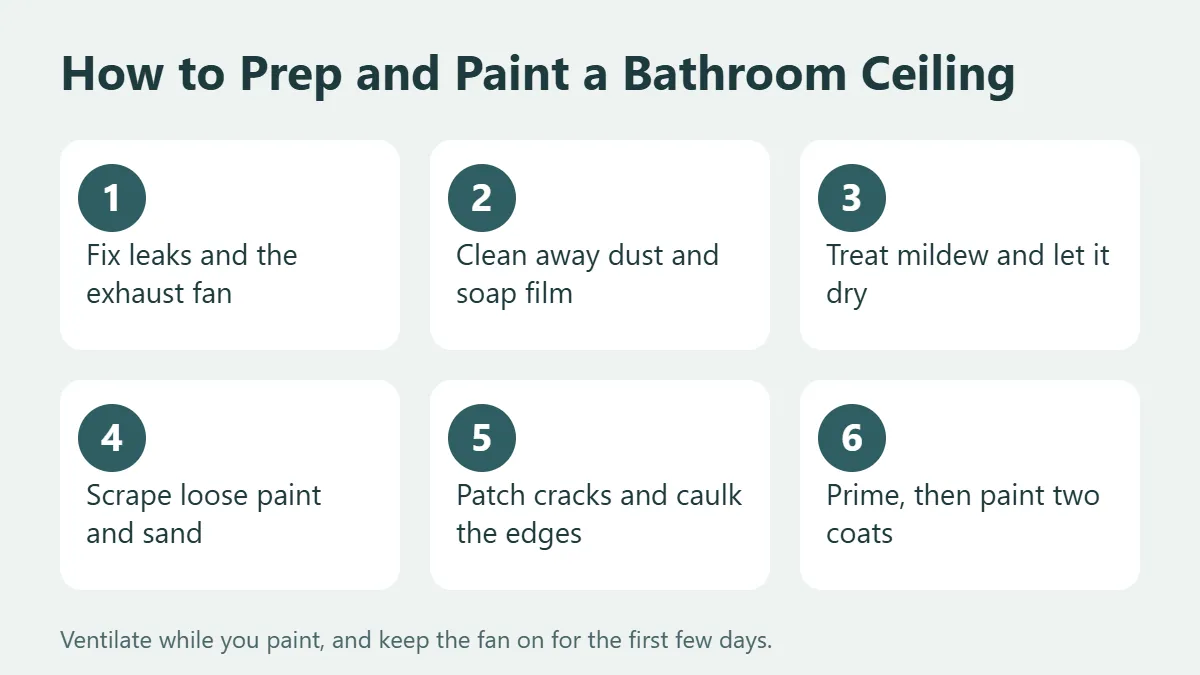
Surface Preparation: The Step That Decides the Result
- Fix the cause first. Repair leaks and improve the exhaust fan before you paint. If the source of moisture remains, any paint will fail.
- Clean the ceiling. Wash away dust, soap film and grease with a mild cleaner, then rinse and let it dry completely.
- Treat mildew. Remove visible mildew with a mold-killing cleaner and let the surface dry. If mold covers a large area or keeps returning, stop and call a pro.
- Scrape and sand. Remove loose, peeling paint and sand rough spots until the surface is smooth.
- Patch and caulk. Fill holes and cracks, and caulk the joint where the ceiling meets the walls.
- Prime. Apply a moisture-resistant primer, especially over stains, bare patches or old peeling.
Preparation matters because paint only sticks as well as the surface beneath it. Skipping steps is the most common reason bathroom ceilings fail.
Tools You Should Use
- A good angled brush for edges.
- A roller with a 3/8-inch nap for a smooth finish.
- An extension pole to reduce strain and keep strokes even.
- Painter’s tape, drop cloths and safety glasses.
- A fan or open window for ventilation while you work.
Application Best Practices
These habits help bathroom ceiling paint level out and bond well:
- Cut in along the edges first, then roll while the edges are still wet to avoid lap marks.
- Roll in one direction, working in small sections.
- Apply thin, even coats. Thick coats sag and dry unevenly.
- Keep a wet edge and avoid stopping mid-section.
- Ventilate the room while painting and for the dry time.
How Many Coats Do You Need?
Plan on one coat of primer and two coats of paint. Some ceiling products claim one-coat coverage, but a bathroom ceiling that is old, stained or being lightened benefits from two coats. Benjamin Moore recommends two coats of Aura Bath and Spa and one or two of its Waterborne Ceiling Paint. A gallon is enough for two coats on most bathroom ceilings.
Drying Time and Curing Time
Drying time is when the paint is dry to the touch and ready for recoating. Curing time is when it reaches full hardness, and it is longer. Benjamin Moore lists a one-hour dry time and a one to two hour recoat time on its ceiling paint. Zinsser asks you to wait 24 hours before showering and 7 days before scrubbing. Follow the can for your product, and keep the fan running for the first few days.
How Long Should Bathroom Ceiling Paint Last?
Manufacturers rarely publish a service life, so treat any specific number with caution. The only verified figure in this guide is Zinsser’s five-year guarantee on its mold and mildew-proof film. In general, lifespan depends on four things:
- Quality of the paint and primer.
- Ventilation and how much steam the room makes.
- How well the surface was prepared.
- How often you clean and maintain the ceiling.
A well-prepared ceiling with a good fan and bathroom-rated paint can outlast a poorly prepared one by years. Inspect it each year and touch up early.
Common Mistakes That Lead to Paint Failure
- Using standard flat ceiling paint in a shower room.
- Skipping primer over stains or bare drywall.
- Painting over mold instead of cleaning and drying first.
- Applying thick coats that sag and trap moisture.
- Ignoring ventilation so humidity stays above safe levels.
- Showering too soon before the paint has dried and cured.
- Buying a metal anti-rust enamel for a drywall ceiling.
When It Makes Sense to Hire a Professional
Call a pro in these situations:
- Mold covers more than a small patch or keeps coming back.
- The ceiling has water stains that suggest a leak from above.
- The paint is peeling in large sheets or the drywall is soft.
- The ceiling has textures, high vaulted sections or hard-to-reach areas.
- You need to repair drywall or add ventilation ducting.
Final Thoughts
The best bathroom ceiling paint is the one that matches your bathroom’s moisture level, not the most expensive can on the shelf. For a steamy shower, pick Zinsser Perma-White in semi-gloss or satin. For a well-ventilated room with a clean, modern look, Benjamin Moore Waterborne Ceiling Paint or Aura Bath and Spa is a strong choice. Prepare the surface carefully, prime it, vent the room and the paint will do its job.
Ready to start? Check your exhaust fan, pick a mildew-resistant paint for your sheen and moisture level, and ask your paint dealer for the product data sheet before you buy.
How This Guide Was Prepared
Product facts come from the manufacturers’ own product pages: Benjamin Moore (Aura Bath and Spa, Waterborne Ceiling Paint), Sherwin Williams (Premium Ceiling Paint, Emerald Interior Acrylic Latex), Zinsser, Valspar and BEHR. Moisture and humidity guidance comes from the US Environmental Protection Agency’s mold course. Where an official page did not list a number, this guide says so and does not guess.
Three points to note. Benjamin Moore describes Aura Bath and Spa as low VOC on one line and zero VOC range on another, so check the can. Sherwin Williams’ page for Emerald did not confirm a mildew-resistance claim. The PPG Timeless page now redirects to Pittsburgh Paints and showed no specs, so it is not used here. Always confirm with the current label.
FAQs on Bathroom Ceiling Paint
What is the best paint for a high moisture bathroom?
Use a water-based acrylic latex paint with a mildew-resistant film in satin or semi-gloss, over a moisture-resistant primer. Zinsser Perma-White is built for this and carries a five-year mold and mildew-proof film guarantee.
Can you use normal ceiling paint in a bathroom?
Only in a dry, well-ventilated bathroom, and only if it is mildew resistant. Standard flat ceiling paint absorbs steam and often peels or grows mildew over a shower.
How long after painting a bathroom ceiling can I take a shower?
Wait at least 24 hours, as Zinsser instructs for paint near a shower, and keep the fan on. Paint may feel dry within an hour but takes longer to cure, so follow your can.
Is it okay to paint the bathroom ceiling and walls the same color?
Yes. It makes a small bathroom feel larger and cleaner. Use a finish suited to the steamiest surface, such as satin on both.
Do I need special paint for a bathroom ceiling?
Yes, in most cases. Look for a mildew-resistant, moisture-resistant formula, because bathrooms have steam and condensation that ordinary ceiling paint does not handle well.
What colors not to paint a bathroom?
Avoid very dark, saturated colors on a windowless ceiling, and grayed shades that look flat in dim light. Test a large sample before committing.
What kind of paint should I use on a bathroom ceiling?
Use water-based acrylic latex that states mildew resistance. Choose semi-gloss or satin for steamy rooms, or a mildew-resistant flat or matte for ventilated ones.
Should bathroom ceiling paint be flat or satin?
Satin is the safer choice for a shower bathroom. Flat or matte works if it is a mildew-resistant bathroom or ceiling formula and the fan is strong.
What is the best paint for a bathroom ceiling?
For most homes, Zinsser Perma-White, Benjamin Moore Aura Bath and Spa and Benjamin Moore Waterborne Ceiling Paint lead the list. Choose by sheen and how much steam the room makes.
How many coats of paint should you put in a bathroom?
Apply one coat of primer and two coats of paint. Benjamin Moore recommends two coats of Aura Bath and Spa and one or two of its Waterborne Ceiling Paint.